In short
- GEO is an extension of SEO for agencies: it adds AI-answer testing, mention and citation monitoring, source diagnosis, and separate reporting rather than replacing SEO fundamentals.[1]
- SEO measures rankings, organic traffic, and conversions, while GEO also examines mentions, recommendations, cited URLs, answer context, grounding queries, and observable AI referrals.[1]
- Google says AI Overviews and AI Mode do not require special AI files or schema, so agencies should avoid presenting invented technical GEO requirements as mandatory.[9]
- The original GEO paper reports answer-visibility improvements under a controlled retrieval experiment, but it does not prove gains in rankings, traffic, or sales.[4]
- The strongest client model is two coordinated scorecards: conventional SEO outcomes plus clearly labeled, repeatable AI-answer observations.[11]
Table of contents
- What is the difference between GEO and SEO?
- Which deliverables change for an agency?
- How do GEO and SEO measurement differ?
- What skills does GEO add to an SEO team?
- Does GEO require different technical SEO?
- What does the GEO research actually prove?
- How should agencies explain GEO to clients?
- Which service should an agency sell?
- FAQ
- Sources
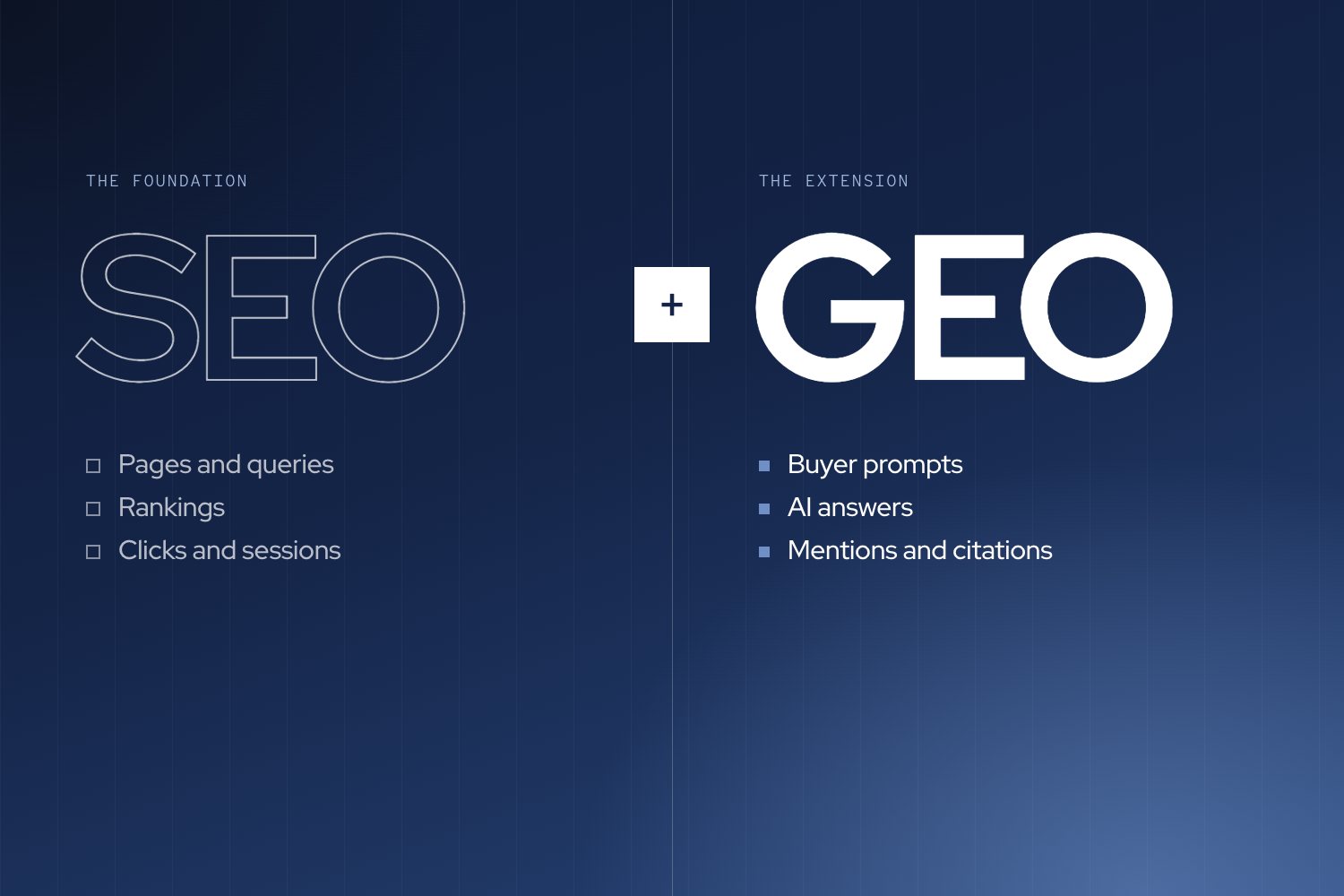
For an agency, GEO is an extension of SEO rather than a replacement for it. SEO focuses primarily on helping pages earn organic rankings and visits, while GEO adds structured testing of buyer questions in AI systems, monitoring brand mentions and citations, diagnosing which sources influence answers, and reporting AI-answer visibility separately from rankings and traffic.[1]
The practical difference is not that agencies abandon technical SEO, content, internal linking, authority, or measurement. Google says its AI Overviews and AI Mode are rooted in core Search systems, that established SEO practices remain relevant, and that publishers do not need special AI files or schema to appear in those features.[2][3] GEO changes the unit of work and analysis: the agency evaluates whether a brand is accurately represented and cited in answers to real questions across named AI platforms.
What is the difference between GEO and SEO?
SEO is generally organized around webpages, queries, rankings, clicks, organic sessions, and conversions. Typical agency work includes keyword mapping, on-page improvements, internal linking, crawl diagnostics, backlink activity, Core Web Vitals triage, structured-data validation, and ranking reports.[4]
GEO, also called generative engine optimization, examines how AI systems retrieve, summarize, cite, and recommend information. A GEO engagement may track a fixed prompt set across platforms, save answer text and cited URLs, compare competitors, identify factual gaps, and recommend changes to the client’s content or wider digital presence.[1]
The distinction matters because an AI answer can mention a company without producing a click, and a cited page is not necessarily the page that ranks first in a conventional search result. Conversely, strong SEO can support GEO because indexed, useful, authoritative content remains part of the information environment that search and AI systems use.[5]
GEO vs SEO at a glance
| Dimension | SEO-centered agency service | GEO or AI-search extension |
|---|---|---|
| Primary unit | Pages, queries, rankings, and organic results.[4] | Buyer prompts, AI answers, mentions, recommendations, and cited sources.[4][1] |
| Main objective | Earn rankings, qualified organic visits, and conversions.[1] | Improve accurate visibility and representation in AI-generated answers.[5] |
| Typical deliverables | Keyword mapping, technical audits, on-page work, internal links, authority work, and rank reporting.[4] | Prompt inventories, repeatable answer checks, saved responses, citation analysis, source diagnosis, and buyer-answer briefs.[1] |
| Core metrics | Rankings, impressions, clicks, organic sessions, click-through rate, leads, and conversions.[4] | Mentions, citations, recommendations, answer context, share of voice, cited URLs, grounding queries, and observable AI referrals.[1][5] |
| Main technical foundation | Crawlability, indexability, information architecture, content quality, links, and structured data.[1] | The same foundation, plus prompt testing, source-level analysis, answer monitoring, and coordination around factual accuracy.[1] |
| Client reporting | Search visibility, traffic, leads, revenue, and progress against SEO targets.[5] | A separate AI-answer scorecard that distinguishes observations from attributable visits and commercial outcomes.[4][5] |
The GEO column describes an illustrative service model drawn from industry analyses, not a universal or officially defined agency menu.[4]
Which deliverables change for an agency?
A conventional SEO retainer can often be planned around a site audit, keyword set, content calendar, technical backlog, link activity, and monthly performance report. GEO adds an answer-observation layer that must be defined carefully so the agency is not simply selling another dashboard.
A practical GEO workstream can include:
- Define the prompt set. Build representative questions around customer problems, comparisons, categories, locations, products, and buying stages rather than testing only brand-name searches.[5]
- Name the platforms. Record which AI systems are included, because answer behavior, available reporting, and citation visibility vary by platform.[5] Even within Google, Finseo’s own analysis of 45,024 prompt-days found that AI Mode and AI Overviews share only 13.7% of cited URLs on the same query.
- Capture a baseline. Save the date, prompt, platform, answer, brand mentions, competitor mentions, cited pages, and any factual or positioning problems.[1]
- Diagnose the source pattern. Identify which pages, publishers, reviews, forums, product pages, or other sources appear in relevant answers and where the client is absent or misrepresented.[5]
- Assign fixes to the right team. Some fixes belong to content or technical SEO; others may require digital PR, reputation work, product-data maintenance, or subject-matter review.[1]
- Repeat the same checks. Use a consistent prompt set and review criterion so changes can be compared rather than presenting isolated answer screenshots as proof of progress.[1]
This can result in buyer-answer briefs, content updates, source and citation audits, factual corrections, digital PR recommendations, and platform-specific monitoring. These deliverables should be presented as an extension of existing agency capabilities, not as evidence that Google has introduced a separate GEO ranking system.[4][1]
How do GEO and SEO measurement differ?
SEO measurement is comparatively mature at the platform level. Agencies commonly combine rankings, Search Console impressions and clicks, organic sessions, click-through rate, leads, revenue, and other conversion data.[4]
GEO measurement is more fragmented. A useful report may distinguish:
- Mention: the brand is named in an answer.
- Citation: the answer links to or cites a page associated with the brand.
- Recommendation: the answer presents the brand as a suitable option.
- Position or prominence: the brand appears early or prominently in the answer.
- Context: the wording is positive, neutral, negative, accurate, or incomplete.
- Source visibility: the pages and domains that are cited for relevant questions.
- AI referral: a measurable visit arrives from an AI platform.
- Commercial outcome: a lead, sale, or pipeline event can be connected to that visit or another defined attribution method.[1]
These observations must not be collapsed into one unsupported score. The cited research does not establish a universal official cross-engine GEO visibility metric, and Google’s cited guidance describes AI-feature traffic as part of overall Search Console traffic rather than providing a separate AI-feature-only metric.[4]
Bing Webmaster Tools provides an example of platform-specific AI reporting: its AI Performance report includes citation activity, cited pages, trends, and grounding queries across Copilot and partner experiences.[6] Microsoft warns that citation counts do not establish ranking or a page’s role in an individual answer, and sparse grounding queries may not appear.[7]
OpenAI says public websites can appear in ChatGPT Search and that referral URLs include utm_source=chatgpt.com, which can help agencies identify some ChatGPT Search visits.[8] That signal still measures attributable traffic, not every answer mention or interaction that produces no click.[5]
What skills does GEO add to an SEO team?
The existing SEO skill set remains relevant. Technical SEO supports crawling and indexing; content teams improve usefulness and clarity; authority and digital PR work can influence the external information environment; and analytics teams connect visibility with business outcomes.[1]
GEO adds several analytical and operational skills:
- Prompt design based on real customer questions and buying situations.
- Cross-platform answer testing and versioned evidence capture.
- Citation and source analysis.
- Fact-checking and brand-representation review.
- Understanding retrieval, grounding queries, and answer synthesis.
- Separating mentions, citations, recommendations, referrals, and conversions.
- Coordinating content, PR, technical, product, legal, and subject-matter owners.
- Explaining uncertainty to clients without turning variable AI answers into guaranteed placements.[4][5]
An agency does not necessarily need a separate GEO department. In many cases, the more useful structure is a shared operating model: SEO owns durable site foundations, content owns answerable information, PR supports third-party source visibility, and analytics defines what can actually be attributed.
Does GEO require different technical SEO?
Usually, no. Google says AI Overviews and AI Mode use core Search systems, that pages must be indexed and eligible to appear with a snippet to be considered as supporting links, and that there are no additional technical requirements or special optimizations for these features.[9][2]
That means agencies should be cautious about selling proprietary technical checklists as mandatory Google GEO requirements. Crawl access, indexability, useful text, clear site architecture, relevant structured data, and strong page experience remain sensible SEO work, but they are not proof of AI-answer visibility.[1]
SEO.co lists AI-crawler access and llms.txt among possible GEO workstreams, but Google explicitly says publishers do not need new AI text files or special schema.org data for its AI features.[4][9] Agencies can still investigate crawler access where it has a defined operational purpose, but the recommendation should not be framed as a universal Google requirement.
What does the GEO research actually prove?
The original GEO paper tested nine optimization methods using a benchmark of 10,000 queries. Its experimental setup supplied the top five Google sources for each query to GPT-3.5-Turbo and generated five answers per query.[10]
The paper measured answer visibility with Position-Adjusted Word Count and Subjective Impression, rather than organic traffic, revenue, or sales. It reported that citations, relevant quotations, and statistics produced relative improvements of roughly 30–40% on Position-Adjusted Word Count and 15–30% on Subjective Impression, with results varying by query domain.[10]
That evidence supports a narrower agency claim: improving how an already retrieved source is represented in a generated answer may improve answer visibility under the tested conditions. It does not prove that GEO edits cause organic discovery, higher rankings, referral traffic, or conversions.[4]
What does the original GEO paper measure?
The paper evaluates generated-answer visibility using Position-Adjusted Word Count and Subjective Impression. Its experiment modifies sources that are already present in a top-five retrieval set, so the results do not establish that GEO changes improve discovery, rankings, traffic, or conversions.[1]
How should agencies explain GEO to clients?
The clearest explanation is that SEO and GEO answer different reporting questions:
- SEO asks: Can the client’s pages be discovered, indexed, ranked, clicked, and converted?
- GEO asks: When a buyer asks an AI system a relevant question, is the client mentioned, represented accurately, recommended where appropriate, and supported by credible sources?
- Combined reporting asks: Are improvements in search and answer visibility contributing to qualified demand and measurable business outcomes?
Agencies should maintain two scorecards rather than replace established SEO metrics with answer screenshots. Each GEO observation should include the prompt, platform, date, captured answer, competitor references, cited pages, issue classification, proposed action, and review criterion.[1]
Client contracts should also state what is and is not guaranteed. Google says AI feature responses and links can vary, and an industry recommendation is to define a baseline, named platforms, repeatable checks, and a review criterion instead of promising placement in a particular answer.[1]
A sensible commercial model prices the added work explicitly. The agency should identify the monitoring scope, diagnosis, accountable fix owner, and review method before charging a separate GEO fee.[1]
Which service should an agency sell?
Most agencies should sell SEO plus an AI-search extension, not GEO instead of SEO. SEO remains the foundation for discoverability, indexability, useful content, authority, and measurable organic acquisition.[1][5]
A GEO layer is most useful when a client:
- Has a high-value category where buyers ask comparison or recommendation questions.
- Needs to monitor how products, services, or claims are described by AI systems.
- Sees competitors cited in answers despite having strong conventional rankings.
- Wants to understand AI referrals and assisted conversions.
- Operates in a regulated or reputation-sensitive sector where factual errors matter.
- Has enough content, analytics, and operational capacity to act on findings.
The correct service mix depends on the client’s objective. A site with serious crawl or indexation problems should not begin by purchasing answer monitoring. A technically sound brand that is absent from important buyer answers may benefit from prompt research, citation analysis, content improvements, and third-party source work alongside its existing SEO program.
Frequently asked questions
Is GEO replacing SEO for agencies?
No. Google says its AI Search features are rooted in core Search systems and that established SEO best practices remain relevant.[3] GEO adds prompt testing, answer monitoring, citation analysis, and AI-specific reporting rather than eliminating technical SEO, content, or authority work.[1]
What is the difference between AEO and SEO?
AEO, or answer engine optimization, generally focuses on making information easy for answer systems to extract and present, while SEO covers broader organic discovery and search performance. In agency practice, AEO and GEO are often used for overlapping AI-answer work, but the research does not identify a single official industry-standard distinction between the terms.[4][1]
Does Google require special GEO schema or an llms.txt file?
Google says publishers do not need new AI text files or special schema.org data to appear in AI Overviews or AI Mode.[5][1] Agencies should continue applying relevant technical SEO and structured-data practices, but should not present a special Google GEO markup requirement as established guidance.[9]
How should an agency measure GEO success?
Use a repeatable prompt set and record mentions, citations, recommendations, answer context, cited URLs, competitor visibility, and platform-specific signals.[1] Report AI referrals and conversions separately where they can be observed, because a mention or citation does not necessarily produce a click or sale.[4][1]
Can GEO guarantee that an AI tool recommends a client?
No. AI responses and links can vary, and the available evidence does not support guaranteeing a particular recommendation in a particular answer.[5] Agencies should define the platforms, baseline, prompt set, review period, and success criteria instead of promising fixed placement.[9]
Does GEO improve organic rankings?
The research does not establish that GEO edits improve organic rankings. The original GEO experiment evaluated visibility within generated answers after modifying sources already present in a retrieval set, so it does not prove effects on discovery, rankings, traffic, or conversions.[10]
Sources
- [1]GEO agency vs SEO agency: do you need both? - Onely — onely.com
- [2]AI Features and Your Website | Google Search Central | Documentation | Google for Developers — developers.google.com
- [3]Google's Guide to Optimizing for Generative AI Features on Google Search | Google Search Central | Documentation | Google for Developers — developers.google.com
- [4]SEO Agency vs GEO Agency: Task and Duty Comparison | SEO.co — seo.co
- [5]How to build a meaningful AI search visibility dashboard — searchengineland.com
- [6]AI Performance - Bing Webmaster Tools — bing.com
- [7]Introducing Ai Performance In Bing Webmaster Tools Public Preview — blogs.bing.com
- [8]Publishers and Developers - FAQ | OpenAI Help Center — help.openai.com
- [9]How to Choose a GEO Agency: Claims to Test | Redlio Labs — redliolabs.com
- [10]GEO: Generative Engine Optimization — arxiv.org
- [11]How We Built a Content Optimization Tool for AI Search [Study] — semrush.com